Moving from another tool
Bring your clients, time, catalog, and invoices over from another app, in the right order.
Updated Nov 18, 2026
You can bring your existing data over from another app or a spreadsheet. Only an Admin can import. A teammate who is not an Admin sees Only an Admin can import data. Importing never emails clients, starts reminders, adds Pay links, or charges anyone. If an import looks wrong, you can undo it from Import history.
What to bring over, and in what order
On Settings, then Data, then Import, start with What would you like to import? The choices are Clients and contacts, Projects, Tasks, Time entries, Catalog, and Invoices (with line items and payments). The page suggests this order: import clients and contacts first, then projects, tasks and time, then invoices. Read the guide: Import invoices and Read the guide: Moving from another tool open those guides. Running the same file again fills empty fields and does not create a second copy of a client or contact that is already there.
-
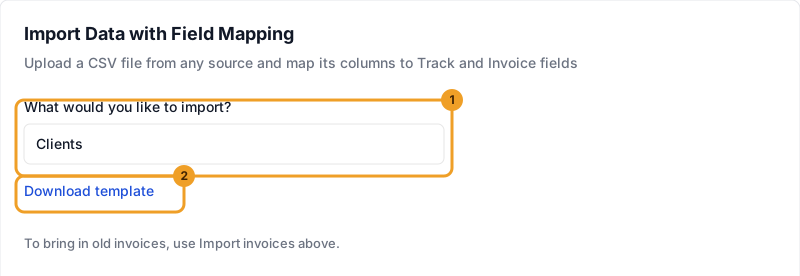
Clients and contacts. One row is one person. Rows with the same company become one client with several contacts. If no row is marked default, the first person for that company is the default contact. Download template gives you the columns if you are not coming from Harvest or Moxie.
-
Projects and tasks, if you use them. Choose Projects, then Tasks, in Field Mapper. A time-entry import can also create projects and tasks that are not there yet. A new project's hourly rate is the rate that appears most often on its rows. An existing project keeps the rate it already has. Clients still need to exist first.
-
Time entries, with Field Mapper. Choose Time Entries.
-
Catalog: products and services. Choose Catalog (products & services) in Field Mapper.
-
Invoices, with line items and payments. Choose Invoices (with line items and payments). See how to import invoices.
Harvest
In Harvest, an administrator opens Manage, then Clients, then Import/Export. Export client contacts as CSV for the people, and export clients as CSV if you want mailing addresses. The contact file uses Client, First name, Last name, Title, Email, Office phone, Mobile phone, and Fax. Track and Invoice recognizes a Harvest file on its own and fills in a recommended mapping you can change. On Clients and contacts, Client maps to the company, and First name, Last name, Title, Email, and Office phone are filled in. Office phone maps to Phone. Map Mobile phone yourself if that is the number you want to keep. Export projects from the Projects section, and time from Reports, then Time, as CSV. Invoice exports from Harvest's invoices report use columns such as ID, Client, Issue Date, Invoice Amount, and Paid Amount, and those are filled in for you.
Moxie
In Moxie, the workspace owner opens Settings & administration, then Data import / export, then the Export tab, and downloads the workbook. Upload that workbook as it is. You do not have to save each sheet as a CSV first. The page lists the sheets and suggests the one that matches what you are importing, such as contacts, projects, time, invoices, or payments. Moxie does not publish one fixed set of column names, so check the sheet you picked. Track and Invoice recognizes a Moxie sheet on its own and fills in a recommended mapping you can change. For contacts, that fills Client, First, Last, Email, Phone, and Role. For invoices, Moxie's invoice export includes Invoice number, Client, Sent, Due, Status, Total, Payments, Date paid, and Paid by, and Paid by maps to Payment method. On the Payments sheet, Paid by is the person who paid, so it is left unmatched and Source maps to Payment method.
While Field Mapper or past-invoice import is running, the page shows a count, such as Importing 25 of 100 rows. Line items and payments get their own count when a past-invoice file includes them. The Import button stays off until that run finishes, so it cannot be started twice.
What goes where
| What you import | Where it shows up | Billed status |
|---|---|---|
| Clients | Clients | Not applicable |
| Projects and tasks | Projects | Not applicable |
| Time entries | Time, and time reports | Already billed or unbilled, from the file or your choice |
| Catalog | Catalog | Not applicable (reusable, not billed) |
| Invoices and line items | Invoices (lines live only on each invoice) | Not applicable |
| Payments | Each invoice's Payment History, and payment reports | Not applicable |
Line items on imported invoices are not time entries. Hours on an old invoice do not appear on Time or in time reports. To see old hours in time reports, also import time entries. Mark them already billed so they never show as Unbilled and do not get billed a second time. When the file does not say whether a row was billed, the import asks you to choose. Mark as already billed keeps that time out of Unbilled. It is not attached to an invoice.
What can't be imported yet
Items (goods, reimbursable purchases, and billable expenses) and Quotes cannot be imported yet. Add them by hand if you need them. Quotes you already sent stay in your old app. You can write a new quote in Track and Invoice when you are ready.
How to export from your old app
These steps were checked in October 2026. Menu names in other apps can change. If something looks different, check that app's own help: Harvest Help Center, FreshBooks Help Center, HoneyBook Help Center, or Wave Help Center. Field Mapper and Import invoices read CSV, TSV, and Excel files (.xlsx and .xls). A file with one sheet goes on to the column matches. A workbook with several sheets shows each sheet's name, row count, and first column names, and you pick the sheet for this import. Empty sheets are listed and cannot be picked. The page selects the suggested sheet, and you can pick another one. The file stays loaded for the rest of the visit, so a later import can use a different sheet. Use a different file starts over with another file, and Cancel import clears the file too.
Harvest
Harvest can export everything you need for the order above.
- Clients: open Manage, then Clients, then export as CSV.
- Projects: open Projects, then export as CSV.
- Tasks: open Manage, then Tasks, then export as CSV.
- Time entries: open Reports, then Time (or Reports, then Detailed time), then export as CSV.
- Invoices and line items: open Invoices, then Report, then New report. Choose Invoice report, then Run report. Then open Export, then Export invoices to CSV. Run the export again and choose Export, then Export line items to CSV. You need both files.
- Payments: open Invoices, then Report, then New report. Choose Payments received report, then Run report. Then open Export, then Export to CSV.
If a menu is not where you expect, the Harvest Help Center has the current names.
FreshBooks
- Invoices: open Reports, then Invoice Details. Set the date range so it covers all of your invoices. Then open More Actions, then Export for Excel. That saves a CSV file, even though the menu says Excel.
- Payments: open Reports, then Payments Collected. Then open More Actions, then Export for Excel.
- Clients: export your client list from the Clients section. If you cannot find the option, the FreshBooks Help Center shows the current steps.
FreshBooks invoice reports do not include each invoice's lines. Imported invoices come in with one line showing the total, unless you build a line items file that matches the sample. Download a sample file is on Invoice file, Line items file, and Payments file under Import invoices.
HoneyBook
HoneyBook does not offer an invoice export.
- Clients: open Clients, then Contacts. Open the three-dot menu, then Download spreadsheet.
- Payments: open Tools, then Reports, then Go to Reports. Choose Payments completed, choose the time frame, then Download. Only account owners and super admins can download reports.
To bring invoices over, make an invoice file in a spreadsheet that matches our sample file (one row per invoice). Use your Payments completed report as a guide for who paid, and how much. Or import only your clients and start fresh. If a menu has moved, the HoneyBook Help Center has the current names.
Wave
Wave sends one combined export.
- Click your business name at the top right, then Business settings, then Data Export.
- Choose Accounting (CSV).
- Open the email Wave sends and click Download data export. The link lasts 24 hours. Download it before then.
- Viewer and Editor roles cannot export. An Owner or Admin in Wave needs to run this.
Customers come out as their own file. Import that file as Clients in Field Mapper. Invoices come out mixed with your other accounting transactions. Copy the invoice rows into a spreadsheet that matches our sample invoice file before you import. Download a sample file on Import invoices shows the columns. If the Wave screen looks different, the Wave Help Center has the current steps.
Excel or Google Sheets
- Go to Settings, then Data, then Import.
- Under Import invoices, each of Invoice file, Line items file, and Payments file has Download a sample file.
- Under Import clients, projects, time and catalog, choose Clients, Projects, Tasks, Time Entries, or Catalog (products & services). Then click Download template. That button appears after you choose a type.
- Copy your data into the same columns. Do not rename those columns if you can help it. Extra columns can be set to Ignore when you match them.
- Upload the Excel file, or a CSV or TSV file. A workbook with one sheet goes straight to the column matches. A workbook with several sheets asks you to pick the sheet, and you do not have to save that sheet as CSV first. In Google Sheets, you can still choose File, then Download, then Comma-separated values (.csv) or Tab-separated values (.tsv) if you prefer a text file.
Need a hand?
If your old app's files do not match, or you are not sure what to bring over, contact us. We will help. Tell us which app you are leaving and which file you are stuck on.
Common questions
No. Import does not send email, start reminders, turn on Pay links, attach receipts, or charge a card or bank account.
No. Many people bring only clients and invoices. Projects, tasks, time entries, and catalog items can come later, or not at all.
Undo it from Import history. Undo... hides the records that import created, when they have not been used since. An imported invoice counts as used only if it was emailed after the import, a payment or refund was recorded after the import, or its lines or totals were edited. Voiding it, or importing it as Sent, does not keep it. Restore... brings that import back. Restore stays available for 90 days after the undo. After that, the row says Restore period ended.
Yes. There's nothing to cancel or pay. Import copies records in. It does not connect to your old app, and it does not turn anything off there.
Did this help?